Anthem + Camp4
Collaboration
Director | Dina Rudick
This page is built for Tim and Jess ahead of our Tuesday meeting. What you'll find here is a quick orientation to who I am, how I work, and the projects I'd want you to know about as we talk about what our collaboration could look like.
The "What I Bring" section lays out the foundations of my practice — my storytelling instincts, the range of work I excel in, the process I bring to every project, and the team behind each piece. The "Selected Work" section is not a complete portfolio, but rather a targeted set of projects, each chosen for what it demonstrates about a specific kind of work I'd love to lead with Camp4. Each project includes a short note from me about why I'm putting it forward, a brief description of the project itself, and a link to watch.
Read what's useful, skip what isn't. I'm looking forward to our conversation!
Who I Am
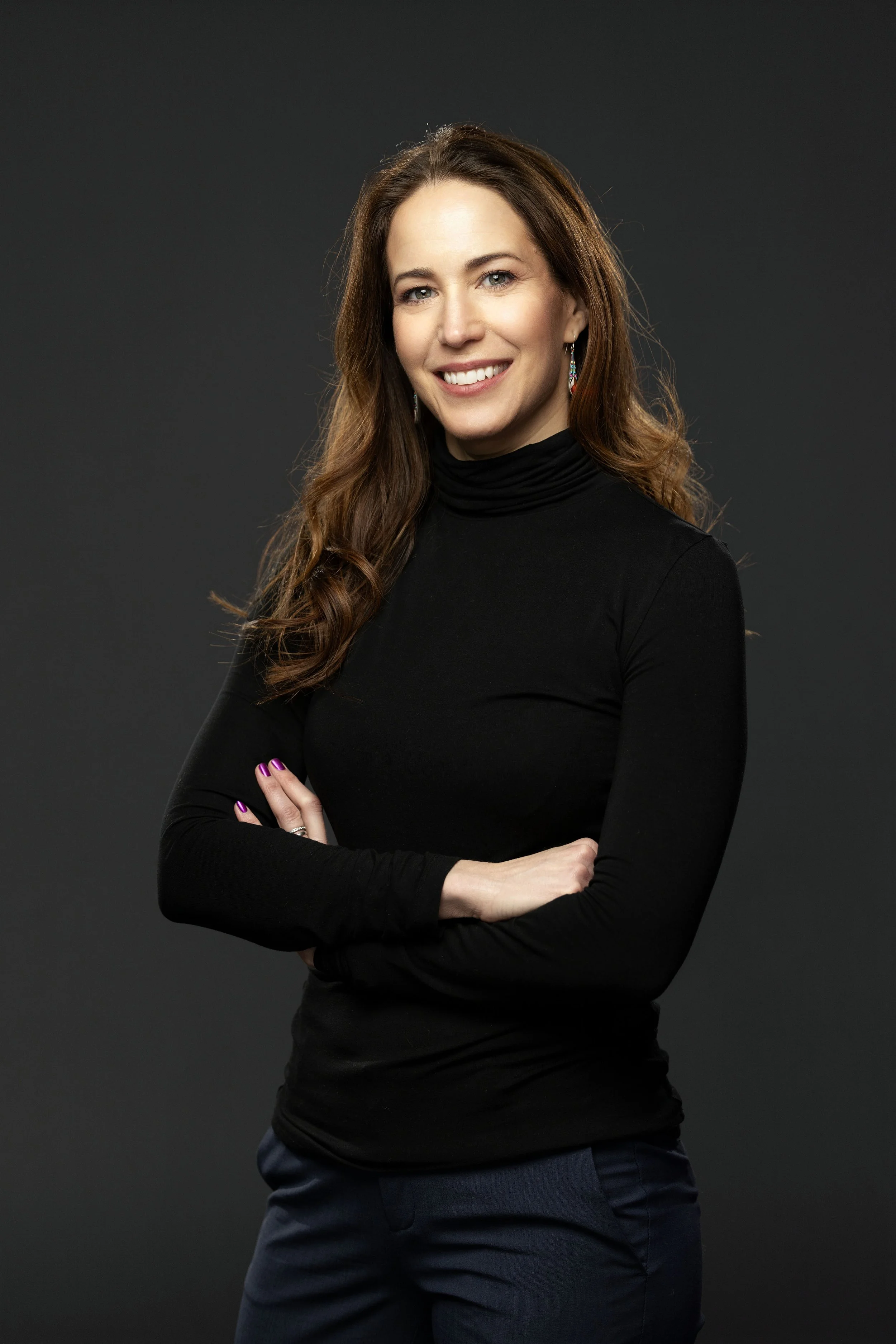
A journalist by ethic, a filmmaker by craft, a science collaborator by conviction.
I spent sixteen years as a staff photojournalist at The Boston Globe, where I helped found the paper's video department in 2008 and led it to its first Emmy win the following year. Anthem Multimedia followed in 2009 — a tight studio specializing in cinematic short-form documentary work for clients in life science, philanthropy, and culture. The work has earned five regional Emmy Awards and screened at festivals around the world, with a multi-month international advocacy campaign on cystic fibrosis sitting at the center of one body of work.
What sustains our work are long creative partnerships — Vertex Pharmaceuticals since 2017, Charles River Laboratories since 2016, and others — built on trust, rigor, and creative custody held from concept through delivery. What I'd bring to a collaboration with Camp4 is what I think we already share: a singular focus on quality – of craft, creativity, and team, while operating with the highest integrity in all areas.
What I Bring
Storytelling Instinct
My storytelling sensibilities are indelibly those of a journalist first, which could be summarized simply as the currency is trust. Seek truth, tell truth, operate with clarity and transparency.
This foundation shapes how I work with sensitive subjects in high-stakes contexts, and how I translate scientifically and medically complex material into emotional, accessible narrative. The aim, always, is storytelling that moves with emotion and economy.
Range
Our work spans fully-realized short-form documentary arcs (Bearing Witness, Where the Earth is Red); conceptual campaigns built around a creative conceit (Vertex Values in Action, Future of Possibilities); fully scripted brand and corporate hero content (Vertex's What Makes Us Unique); and scripted narrative work for branded film (The Storm and The Tree for Convoy of Hope).
Team & Execution
In my years as a filmmaker and business owner, one of the things I’m proudest of is our team. We’ve built a shared shorthand over years of working together, which produces extreme efficiency, multi-hyphenate flexibility, and cinematic choreography executed with minimal friction. The footprint scales to the project (small and surgical, or larger and orchestrated) but the accountability stays consistent: to craft, to client, to subject experience, and to team harmony.
Process
Every project begins with rigorous concepting and pre-production — researching not only the story, the campaign, and the client, but the larger industry, scientific, historical, and societal context that gives the work weight. From there, I hold the vision through delivery: priorities, narrative, imagery, and message kept consistent from pre-pro through post.
In post, my workflow is to sift and distill all source content, organize by narrative category, share raw transcripts and selects with clients immediately, and build the paper edit collaboratively before running with V1. With Camp4, I'd be open to porting that full process, or some hybrid of it. I work most often as a creative supervisor with a specific editor I trust, and would collaborate that way here if it fit the needs of the project and team.
What follows is a targeted selection — chosen not for completeness, but for what each demonstrates about the kinds of projects I'm uniquely positioned to lead.
selected work
This film embodies why I believe in the power of storytelling — indeed, of Witness. And the visuals display Anthem’s confident and masterful craft. Anthem co-founder, head of production and director of photography Dylan Trivette won Emerging Cinematographer of the Year in 2024 with this film as his entry — the only documentary to win. We created this film over 2 years with a team that was, at its largest, five people.
My years as a journalist taught me that stories are ubiquitous, every life is an epic, people long to be understood, and the act of bearing witness is invaluable
Bearing Witness:
A Name & A Voice
A short documentary film about journalism, in which four Boston Globe reporters reveal the personal convictions and unshakable stories that drive their work — challenging audiences to see past the monolith of "the media" and recognize the individual humans who propel it forward. It is, for me, a cinematic love letter to the profession that shaped me and to the colleagues who continue to do the work.
Where the earth is red
We created this film for a worthy institution with a tiny budget, but we took on this story because we saw the fully realized vision and wanted to push ourselves to accomplish it regardless of resources. Again, a tiny team - the Zuni chapter consisted only of myself and Dylan and a drone pilot.
A six-minute mission video for BSCP, the Biomedical Science Careers Program. The brief was abstract; the answer was specific. Dominique, a PhD candidate at Brown studying brain cancer, embodies BSCP's thirty-year mission better than any institutional language ever could — her path from homelessness on the Zuni Reservation to neuroscience and back again is the story, told in the place where it began.
A multi-asset campaign for Vertex marking a turning point in cystic fibrosis history — a disease transformed within a few short generations from near-certain death to one for which therapies now exist for over 90% of patients. The narrative ambition outpaced what conventional production could deliver, so we wrote the constraints into the concept itself: seventeen subjects, three custom-built sets, and a full immersive projection program built individually for each person, all shot in two-hour circuits across a single week.
I put this forward because of the visioning required to achieve impact within resource and time constraints. In short, creative problem solving to serve the messaging needs, and thinking far outside the box to achieve it.
What we captured wasn't b-roll. It was something closer to witness — people seeing their own stories reflected back at scale, in a room built just for them.
A Future of Possibilities
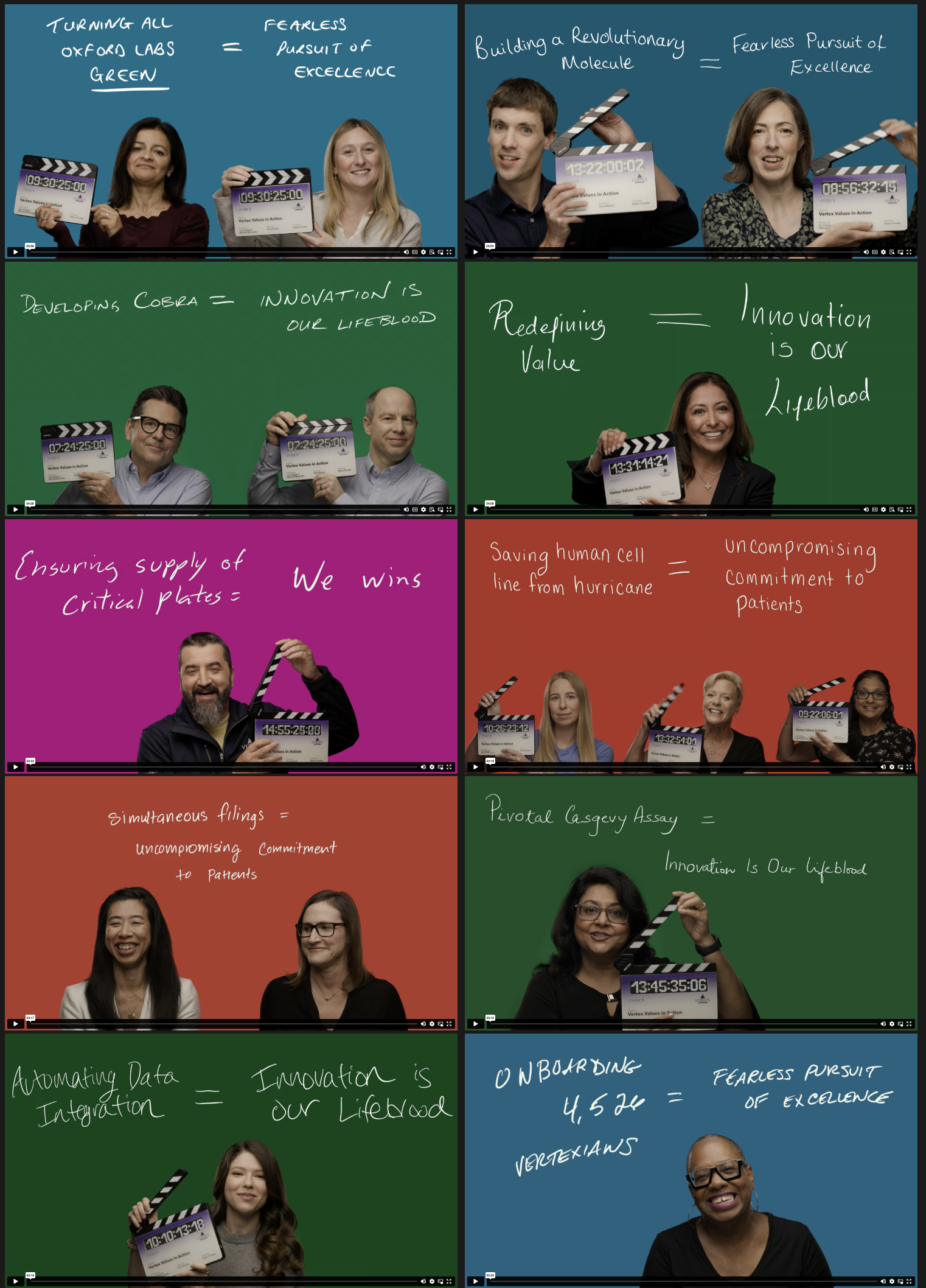
Vertex Values in Action
I put this forward because any mention of a campaign about corporate culture is bound to elicit eye rolls and yawns. But I genuinely admire and believe in this company and there is legitimately a “special sauce” to their scientific magic. So I took on the challenge to make videos about corporate culture irrepressibly interesting, emotional, funny, and relevant.
This is an ongoing series capturing what Vertex's stated values look like in practice — translated from corporate language into human story. The series was concepted by me, in close collaboration with Vertex's internal teams over years of partnership, with each video living at the intersection of brand promise and lived reality. This is a follow-on campaign to a very successful 2024 campaign about Vertex culture — the client said, essentially: “we loved that! Do it again, but different.”
(Click image to open showcase)
This one matters to me for two reasons: subject trust and filmmaking craft. Radhika and Jigar are quite private about their health and lives in general. But they fully participated in telling their stories in raw, powerful ways that we earned as trustworthy partners. As far as craft, I took on the charge to convey fully dimensional people with a complicated yet loving relationship as the priority over conveying a disease state. Our visuals serve to visualize their internal worlds, empathetically situating them as the heroes of their difficult journeys.
Myotonic Dystrophy type 1
Patient Story
(unmastered roughcut, not yet approved)
A patient story in the disease area of myotonic dystrophy type 1, captured over a three-day shoot with a tiny team and subjects who trusted us deeply enough to share what they don't usually share. The roughcut — not yet client-approved — punches well above its production weight in narrative complexity, sensitivity, and authenticity.
What Makes Us Unique
A ninety-second brand film for Vertex, fully scripted in the CEO's voice and capturing the company's scientific ambition, leadership philosophy, culture, and promise to patients. The first draft of the script came to me on a run, which is less a creative affectation than a reflection of how deeply I know this client — after nearly a decade of partnership, Vertex's science, leadership, and values are part of my working vocabulary. The visuals are drawn from years of original material we've captured across Boston, San Diego, London, and Oxford.
This brand film highlights our deep knowledge of our client’s priorities and messaging, as well as the same editorial ethic and cinematographic sensibility, applied consistently across time.
I put this forward as an example of how we’ve pushed into the narrative space to show, rather than tell, an organization’s mission. It’s a story about what it means to plant something for someone else's future, and to live long enough to see it bear fruit
The Storm and The Tree
A nine-minute scripted narrative film for Convoy of Hope, dramatizing their work across four pillars of disaster relief through the story of a Dominican family across generations — anchored by a fruit tree destroyed in a storm, replanted by a child, and standing full-grown a generation later. I wrote and directed; we shot over two days in the Dominican Republic, casting on the fly and working across language barriers from before dawn until long after dark.
How I'd Imagine Working Together
I'm interested in being brought in as a director — and/or as a director-DP duo alongside my long-time creative partner Dylan Trivette — to lead projects across a range of scales and subjects. I'm happy to be introduced to end clients to help elucidate messages and translate them into creative and conceptual approaches, and I'll always do the homework before that introduction.
On post, I can port my full process into a collaboration or some part of it, depending on what fits. I'm an editor by practice, but I'm equally comfortable carrying narrative through to V1 and handing off as I am staying through delivery in a supervising role.
I’m looking forward to Tuesday!
Warmly,
Dina